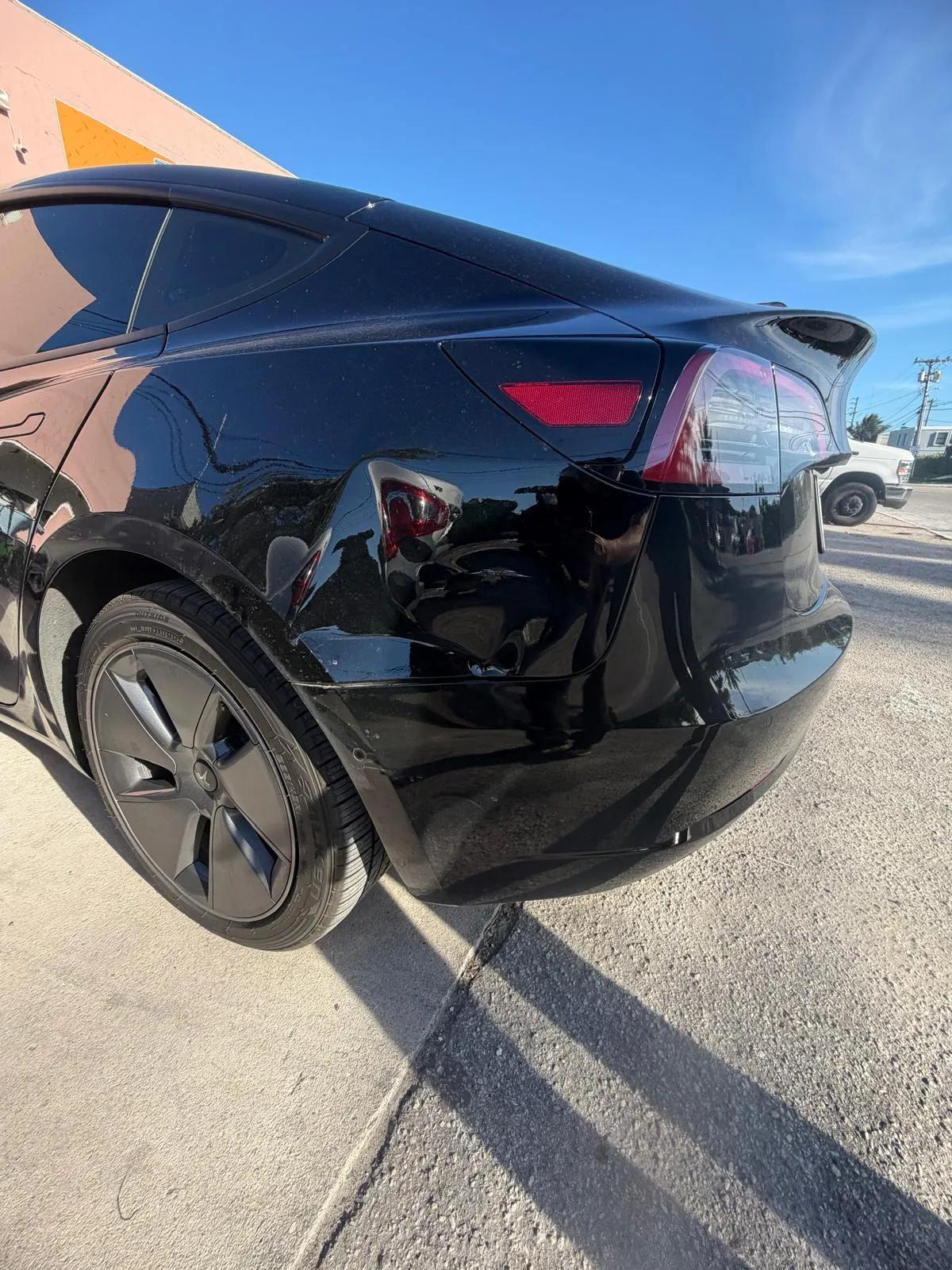
Paintless dent repair works when the paint is completely intact and the metal has not been creased or stretched — a clean, shallow dent in the middle of a panel. It is quicker and keeps the factory finish. Once the paint is cracked, the dent sits on a body line or a panel edge, or the metal has been pushed past its shape, the panel has to be worked and refinished the traditional way. Which one you have is decided by looking at the dent, not by what you would prefer to pay.
What paintless dent repair actually is
Paintless dent repair, usually shortened to PDR, moves the metal back into shape without touching the paint. The technician works from behind the panel with long rods, or pulls from the front with tabs glued to the surface, and massages the dent out a little at a time while reading the reflection under a light.
Nothing gets sanded, filled or sprayed. When it works, the panel keeps its original factory paint, which is the best finish that car will ever have.
That last part is why people ask for it. The problem is that it only works on a specific kind of damage.
When PDR is the right answer
A dent is a good candidate when all of these are true:
- The paint is not cracked or chipped. PDR does not repair paint. If the paint is damaged, the panel needs refinishing no matter how the metal is fixed.
- The metal is not creased. A soft, rounded dent can be massaged out. A sharp fold has stretched the metal, and stretched metal does not go back to where it was.
- It is away from edges and body lines. Styling lines and panel edges are stiff and hard to reach. Dents there rarely come out clean.
- There is access. The tools have to get behind the dent or grip it from the front.
The textbook case is a door ding from a parking lot: small, shallow, in the flat middle of a door, paint untouched.
When it has to be traditional bodywork
Everything outside that list. A dent with cracked paint, a crease, a dent that crosses a body line, one on the edge of a panel, or one where the metal has been pushed well past its shape.
Traditional repair means the panel gets worked back to shape, any low spots are brought up with a thin skim of filler, and then it is primed, blocked straight, painted and blended into the panels next to it so there is no edge for your eye to catch. Done properly, the repair is invisible. Done cheaply, it shows as a wavy reflection or a colour that does not quite match.
Aluminium panels deserve a mention. They are less forgiving than steel under PDR, so a dent that would pop out of a steel door can be a bodywork job on an aluminium one.
The honest trade-off
PDR is usually quicker and cheaper, and it keeps the original paint. Traditional bodywork takes longer because of the paint stages, and it costs more because it includes them.
What you should not do is push for PDR on a dent that is not a candidate. Forcing it tends to leave a panel that is almost straight, with a ripple that shows in every reflection, and then it needs bodywork anyway. The same logic is behind why we usually put on a new bumper cover instead of patching a damaged one: the cheaper-looking option is not always the cheaper one.
If you want to see how we work a panel from dent to paint, our dent and panel repair page walks through it.
How to read your own dent
- Look at the paint up close. Any crack, chip or flaking means paint work.
- Look at the reflection. A soft dip is a better sign than a sharp line through it.
- Check where it sits. Middle of the panel is good news. On a body line or right at an edge usually is not.
- Send a photo. One straight on and one at an angle tells us most of what we need.
FAQs
Can every dent be fixed with paintless dent repair?
No. It only works when the paint is intact and the metal has not been creased or stretched. Cracked paint, a sharp crease, or a dent on a body line or panel edge all mean the panel needs traditional bodywork and paint. Anyone who promises PDR before seeing the dent is guessing.
Is paintless dent repair cheaper than traditional bodywork?
Usually, because there is no sanding, priming or painting involved. The saving only exists when the dent is a real candidate. Forcing PDR on the wrong dent tends to end in bodywork anyway, and then you pay for both.
Does paintless dent repair keep the original paint?
Yes, and that is its biggest advantage. The factory finish is never touched, so there is no colour to match and nothing to blend into the neighbouring panels.
How do I know which repair my dent needs?
Check whether the paint is cracked, whether the dent is soft or has a sharp line through it, and whether it sits on a body line or an edge. The quickest way to know for sure is to text us two photos, one straight on and one at an angle.
Related services
What else we do
Craft Collision & Restoration · Serving Lake Worth Beach & West Palm Beach · Free Estimates · Se habla español
Call or text 561 797 0353
Not sure which kind of dent you have?
Text us two photos and we will tell you whether it is a paintless job or a bodywork job — and if it is paintless, we will say so. The estimate is free and there is no commitment.
Free estimate by text. Send photos to 561 797 0353 — one straight on and one at an angle works best. We reply with a price range.